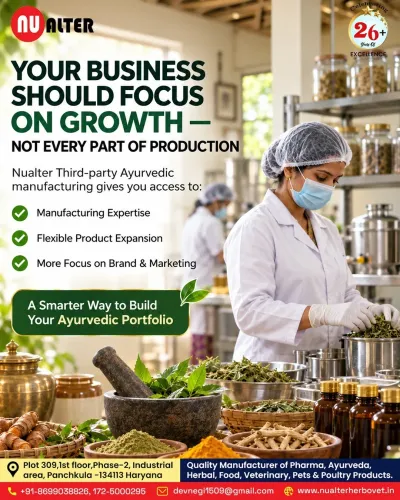

Interest in Ayurvedic and herbal products has created opportunities for distributors, wellness businesses, healthcare entrepreneurs, and marketers to build specialized product ranges. Yet developing an in-house manufacturing facility is not practical for every new business. Third Party Ayurvedic Manufacturing offers an alternative by separating product manufacturing from branding, marketing, and distribution.
For businesses based in Panchkula, Haryana, understanding how this arrangement works can make it easier to evaluate whether outsourced Ayurvedic production fits their business plans.
How Third Party Ayurvedic Manufacturing Works
Under this model, an Ayurvedic manufacturer produces selected products for another business according to agreed requirements and applicable regulatory provisions.
Depending on the manufacturer's capabilities, the portfolio may include different Ayurvedic or herbal product formats and categories.
The process generally begins with product selection. The buyer discusses required formulations, quantities, packaging specifications, branding requirements, and commercial terms with the manufacturer.
After requirements are finalized and the necessary documentation is completed, manufacturing and packaging can proceed according to the agreed arrangement.
Why Emerging Brands Consider Outsourcing
Manufacturing Ayurvedic products requires much more than purchasing ingredients and packaging them.
Production infrastructure, qualified personnel, sourcing processes, manufacturing procedures, quality controls, storage conditions, documentation, and applicable licences can all be involved.
For a healthcare entrepreneur whose primary strength is distribution or marketing, establishing these capabilities from the beginning can divert substantial resources from market development.
Outsourcing allows the business to focus more closely on:
- Identifying suitable market segments
- Developing distributor relationships
- Building its brand
- Planning product positioning
- Managing sales channels
- Expanding into new territories
Manufacturing remains a specialized function handled by the selected production partner.
Choosing Products Requires Market Understanding
One common mistake is selecting products simply because they appear popular.
A better approach is to evaluate the intended customer base first.
A distributor serving general wellness retailers may need a different portfolio from a company focusing on practitioner-oriented Ayurvedic products. Similarly, products suitable for one region may face different levels of demand elsewhere.
Businesses in Panchkula can consider local and regional demand across Haryana while also assessing opportunities in adjoining North Indian markets.
Packaging Is Part of Product Planning
Packaging influences more than visual presentation.
It must suit the nature of the product, required quantity, storage needs, transportation conditions, labelling requirements, and intended market positioning.
Before approving a production order, businesses should clarify available packaging formats and understand which elements can be customized.
Labels and product information should also comply with applicable requirements rather than being designed solely for marketing appeal.
Evaluate the Manufacturing System
A professional evaluation should look beyond quotations.
Useful areas to examine include:
- Relevant manufacturing permissions
- Product categories and dosage forms available
- Ingredient and raw-material controls
- Manufacturing procedures
- Quality-control practices
- Packaging capabilities
- Batch documentation
- Production timelines
- Minimum order requirements
- Repeat-order planning
These factors can directly affect supply consistency as the business grows.
Why Panchkula Is Relevant to Ayurvedic Businesses
Panchkula is connected to a wider commercial network covering Haryana, Chandigarh, Punjab, and nearby North Indian markets. This regional accessibility can support businesses that plan to establish distribution relationships beyond a single city.
Third party manufacturing can therefore be viewed as more than a production shortcut. When approached carefully, it becomes a business structure that allows entrepreneurs to combine specialized manufacturing capabilities with their own strengths in sales, distribution, and market development.
The strongest foundation begins with appropriate products, transparent manufacturing arrangements, proper documentation, and a realistic understanding of the market the brand intends to serve.